
Feature: The Women Who Built Carhartt
Carhartt was built for railroad workers, and the railroad workers were men. Almost everyone sewing the overalls was not.
Almost everyone making them was a woman
Hamilton Carhartt started the company in Detroit in 1889 with a couple of sewing machines and a handful of staff, after talking to railroad workers about what they actually needed. The bib overall came out of those conversations, under the motto "honest value for an honest dollar".
What's less often said is who made them. Carhartt's own company historian, Dave Moore, puts it at roughly 80% of the early factory workforce being women. The company recruited women with sewing experience from the start, because they were the people who knew how to do it.
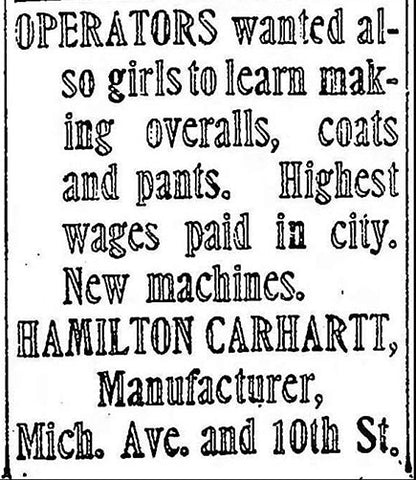
The classified adverts show it plainly. This one went out for machine operators and for girls willing to learn overalls, coats and trousers, promising the highest wages in the city and new machines, from the factory at Michigan Avenue and 10th Street.
The Ladies' Band and the Carhartt Club
By 1901 the factory had its own Carhartt Ladies' Band and Drum Corps, playing at company functions, parades and charity events across Detroit. A newspaper report from that year describes an event at the Detroit factory attended by five hundred girls, which gives you some idea of the scale of the place.
The band was good enough to be noticed outside the factory gates. The president of a Detroit longshoremen's local wrote publicly in praise of them, making the point that a band recruited from factory workers had ignored the ragtime everyone else was playing and stuck to a classical repertoire. Their director, Anna Beyer, said afterwards that they were an ambitious lot and had succeeded quite beyond their expectations.

There was also the Carhartt Club, an industrial club based at the company that took part in forums on labour issues and argued for workers' rights. Its membership was entirely women.
1917: the first thing Carhartt made for them
The women had been making the clothes for nearly thirty years before the company made any for them. The first was a coverall, advertised as a Practical "Allover" for Women and produced by Hamilton Carhartt Cotton Mills in Toronto. The copy is careful to say it isn't a fad but a standard garment, suitable for housework, farm, factory and camping.
Moore describes it as a straightforward thing — something you pulled on over whatever you were already wearing to do work outside. That's what makes it interesting. It wasn't designed as women's clothing so much as work clothing that finally admitted who was doing the work.

The war years
The Second World War did what three decades of advertising hadn't. Women went into shipyards, aircraft plants and factories in numbers, and they needed clothes that would take it. Carhartt's women's coverall from the period is a proper garment rather than an afterthought: shirt collar, four buttons, hip and bust pockets, full back.

And then it took until the 1990s
Here's the part we find hard to get past. A company whose factory floor was overwhelmingly women from the day it opened didn't launch a full women's product line until the late 1990s. Over a hundred years of making the clothes before anyone made a line for them.
How it reached us
The Carhartt we stock is Carhartt WIP, which is a different thing with the same family behind it. In 1989 a Swiss designer, Edwin Faeh, began bringing American products including Carhartt into Europe. He set up Work In Progress as the European distributor in 1994, acquired the licence to manufacture Carhartt outside the United States in 1996, and released the first WIP collection the year after.
The first Carhartt WIP shop anywhere in the world opened on Neal Street in 1997, about four miles from where we're sitting.

You'll find the current range in our Carhartt WIP collection.